M3A (3MP Mini HDR 30fps)-HFOV 200°
Overview
The M3A camera is specially developed and designed for humanoid robot applications. It features an ultra-small size and ultra-lightweight design, with dimensions of 17mm x 17mm. It uses a 3MP HDR sensor and can be applied to positions such as the head and torso of humanoid robots. It offers high-quality image effects that have been professionally tuned.
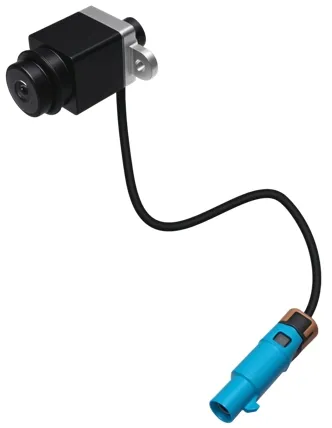
Key Features and Application
Features:
• Output uncompressed YUV data
• High Dynamic Range (HDR)
• Low latency
• Support external trigger
• Multi-camera synchronization
Application:
• Humanoid Robots
• Data collection
• Robot dog
Getting Started
Specification
| Parameter | Value |
|---|---|
| Sensor | RGGB |
| ISP | Built-in |
| Image Size | 1/2.42 inch CMOS |
| Output Pixels | 1920H*1536V |
| Pixel Size | 3.0um*3.0um |
| Frame Rate | 1920*1536@30fps (MAX 60fps) |
| HDR Support | Yes |
| LFM | Yes |
| Output data | YUV422@8bit |
| Serializer | MAXIM MAX96717 |
| Camera Interface | GMSL2 |
| Power Supply | 9~16V POC |
| Current | Less than 200mA@12VDC |
| Connector | Amphenol Fakra (Z Code) |
| Operating temp. range | -40~+85℃ |
| Dimensions | W: 25mm, L:25mm, H:18.6mm |
| Weight | Less than 50g |
Dimensions

Hardware Overview
Block Diagram

I2C Address Information
| Component | Parameter | Value |
|---|---|---|
| Serializer | Model | MAX96717 |
| I2C Address | 0x80 (8bit address) | |
| GMSL Rate | GMSL2 (6G bps) | |
| Sensor | Model | RGGB |
| I2C Address | 0x34 (8bit address) | |
| Frame Sync | Controlled by MAX96717 MFP7 | |
| Reset | Controlled by MAX96717 MFP0 |
Lens Specifications
| HFOV | VFOV | F.No | EFL | Focus Distance | Depth of Field | Water-proof | Lens Mount |
|---|---|---|---|---|---|---|---|
| 200° | 155° | 2.0 | 1.51mm | 0.4m | 0.15m - INF | IP69K | AA |
Employing Camera
1. Adaptation to NVIDIA® Jetson™ platform

M3A Camera Connect to Nvidia Jetson AGX Orin
Step 1: Installation Steps
- Connect the M3A camera to the SG10A-AGON-G2M-A1 board using the coaxial cable
- Mount the SG10A-AGON-G2M-A1 board onto the Jetson AGX Orin module
- M3A camera Connect the power supply
- SG10A-AGON-G2M-A1 board Connect the power supply
- Power on the system
Step 2: Software Preparation
-Select the appropriate driver package based on your camera type and JetPack version:
-Copy the full link address to DownGit to download
| NO. | JetPack Version | Camera | NVIDIA Jetson Devices | Adapter Board | Download Link |
|---|---|---|---|---|---|
| 1 | JP6.2 | M3A | Jetson AGX Orin Developer Kit | SG10A-AGON-G2M-A1 | Download |
NVIDIA JetPack (Jetpack 5.1.2 or Jetpack 6.0 ) is the official software development kit (SDK) for the Jetson series of development boards. It includes the operating system, drivers, CUDA, cuDNN, TensorRT, and other development tools and libraries. Each JetPack version typically corresponds to a specific Jetson Linux version (formerly known as L4T - Linux for Tegra).
- 36.4.3: L4T R36.4.3 (Jetpack 6.2)
- 36.4: L4T R36.4 (Jetpack 6.1)
- 36.3: L4T R36.3 (Jetpack 6.0)
- 35.4.1: L4T R35.4.1 (Jetpack 5.1.2)
For more information, visit NVIDIA's official Jetson Download Center.
2. Camera Integration with Customer's Self-developed Platform
For customers with their own deserializer who want to adapt our camera (serializer) to their platform, detailed technical coordination is required.
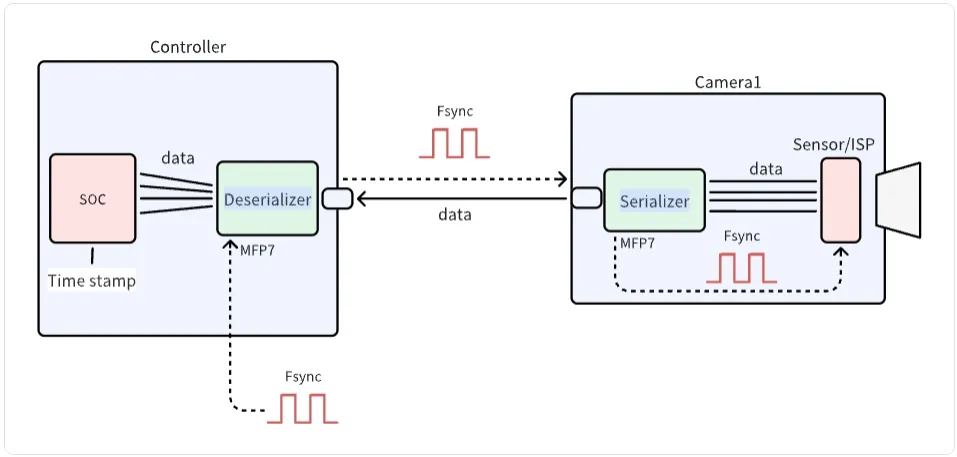
The diagram illustrates the communication architecture between a camera and controller system. It shows how data flows from the Sensor/ISP through the Serializer on the Camera side, across to the Deserializer and SOC on the Controller side. The system utilizes Fsync signals for synchronization and MFP7 interfaces for control. This architecture is essential for proper integration of SENSING cameras with customer-developed platforms.
Step 1: Link Register initialization
SENSING will provide:
-
Serializer and Deserializer Configuration
- Register configuration for the camera module-Getting Camera Information
- I2C communication protocol details
-
Link Status Troubleshooting Guide
- Link training parameters
- Error detection settings
Please refer to the software flow and demo code below to develop your driver code.
Software Development
- Driver Development:
/* Example code for MAX9296 I2C initialization */
#define MAX9296_I2C_ADDR 0x90 // 8-bit address

int max9296_init() {
    // Initialize I2C bus
    i2c_init();

    // disable MIPI output
    i2c_write(MAX9296_I2C_ADDR, 0x0313, 0x00);
    delay_ms(100);
    // Configure link settings for GMSL2 (6Gbps)
    i2c_write(MAX9296_I2C_ADDR, 0x0001, 0x02);

    // Configure linkA and linkB settings for GMSL2 selection (default value)
    i2c_write(MAX9296_I2C_ADDR, 0x0006, 0xC0);

    // Configure MIPI rate 1200Mbps
    i2c_write(MAX9296_I2C_ADDR, 0x0320, 0x2C);

    // enable MIPI output
    i2c_write(MAX9296_I2C_ADDR, 0x0313, 0x02);

    return 0;
}
- Camera Configuration:
/* Example code for   initialization */

#define MAX96717_I2C_ADDR 0x80 // 8-bit address

int camera_init() {
    // Initialize deserializer first
    max9296_init();

    // Reset ISP through MAX96717
    i2c_write(MAX96717_I2C_ADDR, 0x02BE, 0x10); // MFP0 high
    //
    i2c_write(MAX96717_I2C_ADDR, 0x12);
    i2c_write(MAX96717_I2C_ADDR, 0x005B, 0x11);
    //  Configure datatype  YUV422 8bit
    i2c_write(MAX96717_I2C_ADDR, 0x0318, 0x5E);

    //  camera trigger  MFP7  low to  high
    i2c_write(MAX96717_I2C_ADDR, 0x02D3, 0x00); // MFP7 low
    delay_ms(300);
    i2c_write(MAX96717_I2C_ADDR, 0x02D3, 0x10); // MFP7 high

    return 0;
}
Integration Steps
-
BSP Integration:
- Modify the device tree to include the CSI interface configuration
- Add camera driver to kernel build configuration
- Configure media controller pipeline for the camera
-
Application Development:
/* Example code for capturing camera frames */
#include "camera_api.h"

int main() {
    // Open camera device
    int fd = open("/dev/video0", O_RDWR);
    if (fd < 0) {
        perror("Failed to open camera device");
        return -1;
    }

    // Configure video capture format
    struct v4l2_format fmt = {0};
    fmt.type = V4L2_BUF_TYPE_VIDEO_CAPTURE;
    fmt.fmt.pix.width = 1920;
    fmt.fmt.pix.height = 1536;
    fmt.fmt.pix.pixelformat = V4L2_PIX_FMT_UYVY;

    if (ioctl(fd, VIDIOC_S_FMT, &fmt) < 0) {
        perror("Failed to set format");
        close(fd);
        return -1;
    }

    // Request and map buffers
    // ... (buffer setup code) ...

    // Start streaming
    // ... (streaming code) ...

    // Capture and process frames
    // ... (frame processing code) ...

    // Cleanup
    close(fd);
    return 0;
}
Step 2: Data Processing
After receiving the module data through the MIPI CSI interface:
- Data Reception
- MIPI CSI-2 protocol implementation
- Data rate configuration
- Image Processing
- YUV422 data parsing
- Image format conversion
- Display configuration
Technical Support
-
Documentation
- Detailed register descriptions
-
Engineering Support
- Technical consultation
- Debug assistance
- Performance optimization
SENSING Technology provides technical support for integration with most platforms. For detailed documentation, sample code, and technical assistance, please contact our support team.